Best time for a meeting between the US and India: ET, CT, MT and PT across the year
By the Slotlu team · Published
India stays on UTC+5:30 all year while US clocks move twice, so New York is 10 h 30 min behind India from November to March and 9 h 30 min behind for the rest of the year. If both offices keep 9:00–18:00, no US time zone shares a single office hour with India. The smallest stretch is from New York: 9:00 a.m. there is 6:30 p.m. in India in summer and 7:30 p.m. in winter.
Hours apart, by US time zone
We used the planner’s own code to compare each US zone with India (Asia/Kolkata) on a winter day (12 January 2027) and a summer day (15 June 2027), with both people on 9:00–18:00 and a 60-minute call. The last column is the planner’s ranking score for the best start: for each person, the minutes the call starts before their working day plus the minutes it runs past the end of it, added up. Lower is better; 0 would mean a call inside both working days.
| US zone | Behind India, winter | Behind India, summer | 9:00 a.m. US is, in India | Best score (winter / summer) |
|---|---|---|---|---|
| Eastern (New York) | 10 h 30 min | 9 h 30 min | 7:30 p.m. / 6:30 p.m. | 150 / 90 |
| Central (Chicago) | 11 h 30 min | 10 h 30 min | 8:30 p.m. / 7:30 p.m. | 210 / 150 |
| Mountain (Denver) | 12 h 30 min | 11 h 30 min | 9:30 p.m. / 8:30 p.m. | 210 / 210 |
| Arizona (Phoenix) | 12 h 30 min | 12 h 30 min | 9:30 p.m. / 9:30 p.m. | 210 / 210 |
| Pacific (Los Angeles) | 13 h 30 min | 12 h 30 min | 10:30 p.m. / 9:30 p.m. | 150 / 210 |
Between two people the best score is the gap between their working days plus the length of the call. Eastern time in summer is the best case: 9:00 a.m. in New York is 6:30 p.m. in India, so the call runs 90 minutes past Ravi’s 18:00 (a score of 90). The America/Phoenix zone has no daylight-saving changes in the time zone data, so Phoenix is 12 h 30 min behind India all year.
In the same data, Asia/Kolkata has no offset change from 1946 through 2029: it is UTC+5:30 throughout, so all the movement in this table comes from the US side.
The two ways to meet, per zone
With both people on 9:00–18:00, every option asks one side to stay late or start early. For each half of the US day, the table gives the starts with the lowest score; where several starts tie, it shows the whole range:
| US zone | Winter: US morning | Winter: US evening | Summer: US morning | Summer: US evening |
|---|---|---|---|---|
| Eastern (New York) | 6:30 a.m.–9:00 a.m. US / 5:00 p.m.–7:30 p.m. India · score 150 | 7:30 p.m.–9:00 p.m. US / 6:00 a.m.–7:30 a.m. India (next day) · score 330 | 7:30 a.m.–9:00 a.m. US / 5:00 p.m.–6:30 p.m. India · score 90 | 8:30 p.m.–9:00 p.m. US / 6:00 a.m.–6:30 a.m. India (next day) · score 390 |
| Central (Chicago) | 6:00 a.m.–9:00 a.m. US / 5:30 p.m.–8:30 p.m. India · score 210 | 6:30 p.m.–9:00 p.m. US / 6:00 a.m.–8:30 a.m. India (next day) · score 270 | 6:30 a.m.–9:00 a.m. US / 5:00 p.m.–7:30 p.m. India · score 150 | 7:30 p.m.–9:00 p.m. US / 6:00 a.m.–7:30 a.m. India (next day) · score 330 |
| Mountain (Denver) | 6:00 a.m.–8:30 a.m. US / 6:30 p.m.–9:00 p.m. India · score 270 | 5:30 p.m.–8:30 p.m. US / 6:00 a.m.–9:00 a.m. India (next day) · score 210 | 6:00 a.m.–9:00 a.m. US / 5:30 p.m.–8:30 p.m. India · score 210 | 6:30 p.m.–9:00 p.m. US / 6:00 a.m.–8:30 a.m. India (next day) · score 270 |
| Arizona (Phoenix) | 6:00 a.m.–8:30 a.m. US / 6:30 p.m.–9:00 p.m. India · score 270 | 5:30 p.m.–8:30 p.m. US / 6:00 a.m.–9:00 a.m. India (next day) · score 210 | 6:00 a.m.–8:30 a.m. US / 6:30 p.m.–9:00 p.m. India · score 270 | 5:30 p.m.–8:30 p.m. US / 6:00 a.m.–9:00 a.m. India (next day) · score 210 |
| Pacific (Los Angeles) | 6:00 a.m.–7:30 a.m. US / 7:30 p.m.–9:00 p.m. India · score 330 | 5:00 p.m.–7:30 p.m. US / 6:30 a.m.–9:00 a.m. India (next day) · score 150 | 6:00 a.m.–8:30 a.m. US / 6:30 p.m.–9:00 p.m. India · score 270 | 5:30 p.m.–8:30 p.m. US / 6:00 a.m.–9:00 a.m. India (next day) · score 210 |
The planner leaves out any start that puts someone outside their hours at night (22:00–06:00 their time). Evening calls from the US land on the next morning in India, so check the date as well as the time.
The two Sundays that move a recurring call
US daylight saving time runs from 2:00 a.m. on the second Sunday of March to 2:00 a.m. on the first Sunday of November (15 U.S. Code § 260a). In 2027 that is 2027-03-14 and 2027-11-07. India does not change, so a weekly call fixed at 9:00 a.m. New York time moves for Ravi:
| Tuesday | New York | India |
|---|---|---|
| 2027-03-09 | 9:00 a.m. | 7:30 p.m. |
| 2027-03-16 | 9:00 a.m. | 6:30 p.m. |
| 2027-11-02 | 9:00 a.m. | 6:30 p.m. |
| 2027-11-09 | 9:00 a.m. | 7:30 p.m. |
If the invite is created in India time instead, the US side moves by the hour. Create the series in the time zone of the person whose evening or morning you are protecting, and tell the other side which weeks it moves.
A team in three US zones and Bengaluru
Here are you in New York, Dana in Chicago, Sam in San Francisco (Los Angeles time) and Ravi in Bengaluru (Kolkata time), everyone on 9:00–18:00, loaded in the planner for 12 January 2027:

Open this example in the planner →
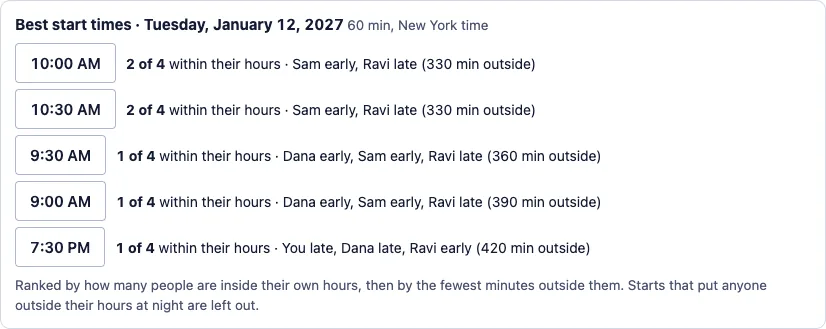
No start puts more than two of the four inside their hours: whichever time you pick, someone in California is early or someone in India is late. The planner then writes one message with every person’s local time, so nobody converts by hand:
Hi everyone,

Proposed time for “US–India sync”:

Tue, Jan 12 · 10:00 AM–11:00 AM EST (New York)
   Dana · Chicago: Tue, Jan 12 · 9:00 AM–10:00 AM CST
   Sam · Los Angeles: Tue, Jan 12 · 7:00 AM–8:00 AM PST
   Ravi · Kolkata: Tue, Jan 12 · 8:30 PM–9:30 PM IST

Reply if it does not work for you.
Sources
- 15 U.S. Code § 260a (Cornell LII): US daylight saving period
- IANA Time Zone Database: the time zone data browsers use for offsets and changes
Pages read on 10 November 2026. Offsets, rankings and messages on this page are computed with the planner’s own code from the IANA time zone data in the browser; open any example to repeat them.
Next steps
- Open the meeting planner with your own team and hours.
- Europe vs US clock changes: the three or four weeks a year when US–Europe meeting times move.
- Schedule a meeting across time zones: the whole workflow from hours to calendar invite.